Globalize Your Wardrobe

The evolution and influence of travel has turned fashion into a global entity. Everyone has their own sense of personal style whether they realize it or not. However, being a well-traveled person with experiences from a multitudinous amount of destinations around the world enhances someone’s sense of style and appreciation of fashion. Going global allows people to step out of their own world, that may cause them to be sheltered from exposure to other cultures and fashion trends. The increased accessibility to travel has caused an evolution and integration of fashion globally in recent decades.

To begin, traveling includes permanent moves, temporary relocating, vacationing, and even the observation of other people’s travel through social media. When someone picks up their things and decides to switch locations, whether for an extensive amount of time or not, they are providing themselves with the opportunity to explore the world of fashion from a standpoint that was never available to them before. A family moves across the country, a teenager attends college away from home, a bachelorette party heads to a tropical vacation, or even a homebody scrolls through the Instagram hashtag “travel”. These are all examples of travel that influence each of these individual’s potential adaptations to their own sense of style. When living in new places people tend to integrate with the social norms. Especially with extensive amounts of time in a new location, people not only begin to adapt to the area, but also adopt. Time allows people to indulge in new cultures or groups of people that they previously may have known little to nothing about. Once new connections have been formed the appreciation of culture can be seen through the relocator’s new sense of style. 

 Subsequently, particular regions and countries have their own styles that they have adopted and adapted over time to fit the needs of cultural groups that are evolving over time, but desire to continue to represent their culture through respected fashion. For example, in the Middle East women have always worn, and continue to wear their hijabs to represent their religion. However, in recent times women are taking advantage of this article of clothing, and using it as an expressive outlet for fashion. The hijab is no longer something women of the Middle East feel obligated to wear, but now they are proud to wear it as it has been coined a symbol of feminism across the world. 

In the end, global fashion differences are not noticed until traveling to any extent and removing one’s self from their expected style and means of dressing. If you feel like your world is too small and your style sense needs global innovations, just step out of your comfort zone and explore the unknown. You will not regret it.

-LJ

Fast Fashion, Slow Death

Fast fashion can be described as the mass production of inexpensive clothing in order to quickly fulfill the latest fashion trends. Fast fashion is responsible for the exploitation of garment workers and the deteriorating health of our planet. Although there are a plethora of solutions to this predicament, without the help of a willful society little to nothing can be accomplished. 

WHAT: The rise of fast fashion derives from the demand for trendy clothes, often marketed through the expanding and instantaneous world of social media. In the past, brands would release one collection per season annually. This equates to two collections per year due to the fact that Spring/Summer and Fall/Winter are the two seasons in the fashion industry. However, brands now release 52 micro-collections every year. This enormous escalation in production defines fast fashion. Moreover, identifying some unethical brands is harder than others. Some of the obvious ones include Shein, Zaful, Forever21, H&M, Asos, Zara, and Uniqlo.  On the other hand, brands such as Urban Outfitters, Anthropologie, and Free People may be more difficult to automatically identify as unsustainable. However, all of these companies have been associated with disregarding ethical, environmental, and human rights issues. 

HUMAN EXPLOITATION: The fashion industry is the most labor intensive industry in the world. Companies blatantly take advantage of people living in low income countries. China, Bangladesh, Vietnam, and India are the four largest apparel exporting nations. Women and children make up the majority of the garment labor industry, 80% of which being women of color. These people are forced to work 14-16 hours a day for seven days a week. After all of this, only 2% of garment workers make a living wage. This means that the other 98% are not making nearly enough to afford a normal standard of living. Not to mention the occurrences where companies refuse to pay their workers, leaving them to fend for themselves. In addition to not being compensated sufficiently for their hard work, garment workers are often forced to work in poor and even often dangerous conditions. In 2013, garment workers in Bangladesh complained to their supervisors regarding the conditions of the building they had been working in. The assertions were immediately dismissed and nothing was inspected. Shortly after, the Dhaka garment factory collapsed killing 1,100 innocent garment workers and injuring thousands more. The complete disregard for the health and human safety of these people caused a catastrophic event that still does not receive the notoriety that it deserves.

ENVIRONMENTAL DEVASTATION: Fast fashion is responsible for the deterioration of the world’s health. To begin with, the fashion industry is the second largest polluter, after the oil industry. This industry negatively affects every aspect of our global ecosystem, from the oceans, to the atmosphere, and even our land. With fast fashion comes mass production resulting in mass consumption, once people believe their clothing is no longer “trendy” they are quick to discard their garments. Sixty percent (60%) of all clothing made is landfilled or incinerated within 1 year of its purchase. Most landfills are located in impoverished countries due to the fact that their land is cheap and their people are vulnerable to major corporations. Companies take advantage of the financial needs of low income nations by offering compensation for the dumping of discarded clothing in their landfills. This results in an overwhelming amount of trash which builds up overtime and pollutes the local environments. When this waste eventually decomposes it produces harmful gases which contribute to global warming. The emission of these gases and others produced by the fashion industry make up 10% of all carbon emissions in the world. Moreover, the fashion industry is the second-largest consumer of the world’s water supply. This water is used to manufacture textiles and dye fabrics. Dying and washing synthetic fabric pollutes our oceans with chemical effluent and millions of microplastics. All of these actions have effects, and all of these effects have detrimental consequences that are contributing to the degradation of our Earth. 

SOLUTION: By now, I hope that this information has made you somewhat uncomfortable with your current purchasing habits and has opened you up to accept change. After all, we need change and we need it now.  The first step is to educate ourselves on the situation. Reading informative articles is always helpful, but I find documentaries to be truly captivating and educational all at once. I recommend watching “The True Cost” on Netflix, “Luxury: Behind the Mirror of High-end Fashion” on Youtube, “The Next Black” on Youtube, and “Riverblue” on Amazon Prime Video. All of these documentaries highlight the “behind the scenes” aspect of the fashion industry that consumers never truly see, but should. The second step is to alter your buying behaviors. It should ultimately be a goal to support and purchase from fast fashion brands less frequently, if at all. Instead, support sustainable companies whose mission is to make a difference within the industry. Apps such as Good On You and Eco-Age can be downloaded on your phone and assist you on your next shopping trip! These applications evaluate and score brands on how ethical they are. Once you know this information, the decision is yours whether or not you would like to support their business. Thrifting is another great sustainable method of shopping. Some people argue that shopping at thrift stores takes away from people in need, and it should not be promoted to everyone. However, more than half of the articles of clothing that are donated to thrift stores do not even make it to the showroom. These second-hand stores have an abundance of clothes that ultimately end up in landfills. In short, read an article, watch a documentary, or download an app to guide you through the fashion industry.

In order to initiate change every aspect of the fashion industry needs to be altered, from production to purchasing. As consumers, we need to modify the way in which we purchase. We need to normalize NOT keeping up with “trends” which fuel fast fashion. In the end, these trends come with costs that not enough people are aware of and willing to change. For the health of our environment and the safety of our garment workers across the world, kill fast fashion or face a slow death.

-Lj
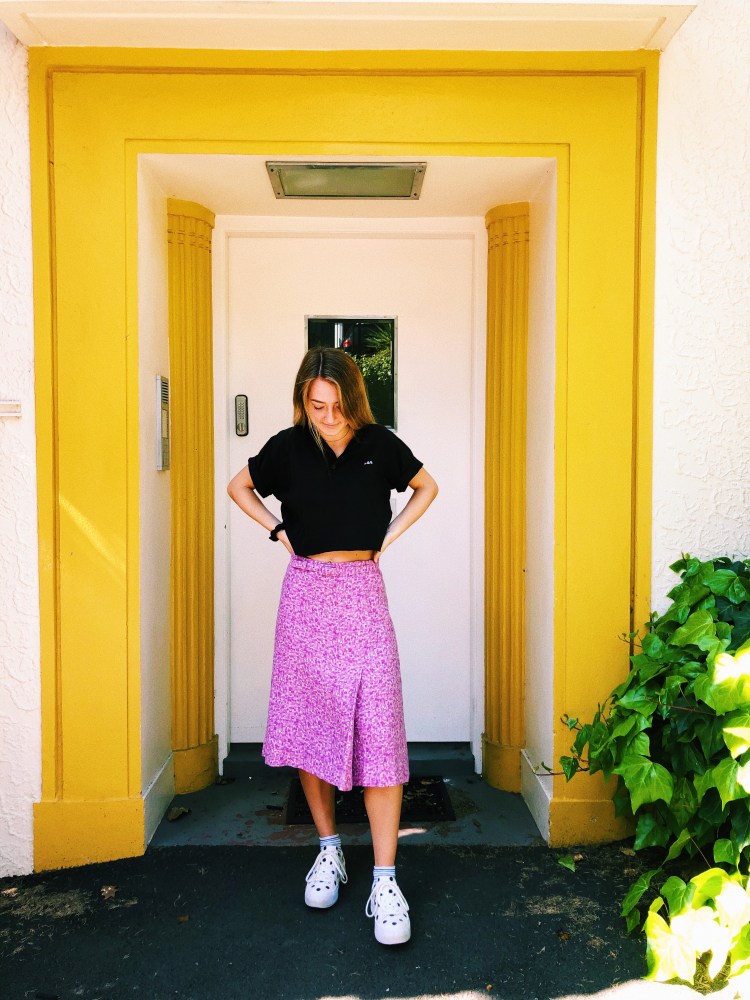
Thrift Shopping: Good for More Than You Think

I have been thrift shopping for approximately 5 years now. Of course, in the beginning I had a much different mindset than I do now. I used to look for articles of clothing that I would find in my favorite stores (Forever 21, American Eagle, etc.). This worked out for me, and I would come home with tops and bottoms that fit into my wardrobe along with everything else that I previously owned from those retail companies. Over time my mindset has developed and changed. When I go thrift shopping now I look for unique pieces that I can already envision myself wearing or potentially wearing after a couple of alterations (hemming, cropping, or adding other fabrics/buttons). I also take into consideration the pieces that I already own at home and think about what would complement them in different outfits. After much consideration and imagining potential additions to my wardrobe, I often come home with new ideas. Some days I am more fortunate than others. The days that I come home with heaps of new thrifted treasures keeps my passion for finding new creations high and balances those days that I may come home with nothing. I love the variety of clothing offered in thrift stores. The likelihood of someone else having the exact same piece is slim to none. Every shirt, skirt, and pair of shoes has their own unique story that I will never know, but adds to its own character. Sustainable clothing is the future and second-hand clothing is a combination of both the past and the future. With increasing awareness of the deteriorating health of our environment, the demand for eco-friendly fashion is on the rise. Virtual water is a concept that explains the unseen consumption of water used in the production of clothes, shoes, and accessories such as purses. It can take 2,700 liters of water to produce the cotton needed to make a single T-shirt, and 2,257 gallons of water to make a single pair of leather shoes (1). We have been stressing the environment for centuries now, abusing our easy access to freshwater, and now we are facing the consequences. However, instead of ignoring the crisis, everyone needs to do their share to contribute to our sustainable future. Thrift shopping is a fantastic start. Not only purchasing from, but also donating to your local second-hand stores. I go through my closet after every season and donate anything I did not wear over the past couple of months. If everyone made it a point to purchase from corporate retail stores less frequently, it would make enough of a difference to matter. Over time, a little hobby I enjoyed doing, turned into a passion and my primary method of shopping for clothes. Clean out your closets and make a stop at your local second-hand stores, not only to benefit you, but also to benefit our planet.

Who is Lj? What does she have to do with fashion?

Hi. I am Lj. My name is Leah Jane Marsh, but I think it is interesting to mix things up sometimes. Just like a stage name, Lj is my “blog name” (or my alter ego) you could say. I am 18 years old and studying fashion merchandising at my state university. Ever since I can remember I have been dressing myself. I always enjoyed that small responsibility my parents had bestowed upon me. I am not sure if it was a genuine method of parenting or the fact that they could not be bothered to dress me themselves, but either way the task became my favorite part of everyday. Of course, a 5 year old does not have a pristine sense of style, but making small decisions for myself as a child has led me to be more independent, confident and openminded to this day. Of course there were special occasions in which my parents would implement a few restrictions on what I could and could not wear. However, other than that I was free to wear whatever my little heart desired. When I would receive compliments, normally from older woman just being kind, I would be so proud of myself knowing that I did what I did all by myself. These small moments constructed my self esteem and passion for fashion that are still continuing to flourish. In recent times I was plagued with the daunting question that haunts every teenager: “What am I going to spend the rest of my life doing as a career?” The answer is nowhere. I would spend days on end trying to imagine myself, a then 16 year old, pursuing a career in a field that interested me. The first thought that came to my mind was a geneticist, then I envisioned myself as a psychologist. I was coming up with a plethora of ideas that sounded marvelous in the moment, but I would soon realize did not actually appeal to me. Eventually, pursuing a career in fashion phased me as a possibility when I stopped attempting to dig deeper than my genuine interests. Sometimes people’s parents push them to aspire to have particularly prestigious careers. However, I knew a career in fashion would be thoroughly supported by my parents due to their carefree nature when I was growing up. Currently, I am on winter break after spending my first semester of my freshman year of college abroad in New Zealand. I have yet to take a fashion course abroad or at my home university, but I am more than excited to begin this adventure. In the meantime, I am revisiting my memories of Auckland’s street style, exploring and purchasing from my local thrift stores, and pondering what my future may look like in the fashion industry. I joined this platform with the hopes to express all that I feel, observe, despise, and love about fashion.

Auckland thrift finds…